
Al Qudra Lake Dubai United Arab Emirates is a chain of man-made lakes in the desert south of the city, free to enter and open around the clock. Flamingos gather here in the winter months, a famous cycle track loops through the dunes beside the water, and the heart-shaped Love Lake sits a short drive away.
- What Al Qudra Lake Dubai United Arab Emirates Really Is
- Where the Lakes Sit and How to Get There
- Entry Fee and Opening Hours
- The Lakes in the Chain
- Flamingos and Birdlife at the Lakes
- The Al Qudra Cycle Track
- Things to Do at the Lakes
- Rules Worth Knowing Before You Go
- What to Pack
- The Best Time to Visit
- Questions Visitors Ask
- Is Al Qudra Lake free to enter?
- Can you swim in Al Qudra Lake?
- When do the flamingos arrive?
- How long is the Al Qudra cycle track?
- Is Love Lake the same as Al Qudra Lake?
- Can you camp at Al Qudra Lake?
- How do I get there without a car?
- Is it good for children?
- A Desert Day That Costs Nothing
Most visitors come for one of three things. They ride the cycle track at dawn, they watch birds at sunrise, or they spread a picnic on the grassy banks in the late afternoon. This article covers all three, with the timings, the route, the rules and the packing list you need for a smooth trip.
What Al Qudra Lake Dubai United Arab Emirates Really Is
The name covers a chain of more than ten man-made lakes, not a single body of water. They sit inside the Al Marmoom Desert Conservation Reserve, the first unfenced nature reserve in the UAE, along Al Qudra Road (D63) in the Saih Al Salam desert.
The lakes were built to support wildlife in the desert. They worked. Water, reeds and trees now draw birds, oryx and gazelles into a landscape that would otherwise be bare sand.
Al Qudra Lake Dubai United Arab Emirates surprises first-time visitors because it looks nothing like the city less than an hour away. There are no ticket gates, no queues and no gift shops. The visit costs nothing except the drive there.
Where the Lakes Sit and How to Get There
The lakes sit about 40 kilometres south-east of Downtown Dubai, roughly a 30 to 50 minute drive depending on traffic and your starting point. Take Al Qudra Road (D63) out past Arabian Ranches and Dubai Studio City, following signs for the Al Marmoom Desert Conservation Reserve.
From Dubai Marina the drive takes around 40 minutes. From Downtown Dubai it takes around 45 to 50 minutes. From Abu Dhabi, allow about an hour and 45 minutes via the E311 and Al Qudra Road.
No public transport reaches the lakes, so a car or a taxi is the only practical option. Navigation apps know the main lakes by name, so search for your chosen lake before you set off rather than the general area.
| Starting point | Drive time | Route |
|---|---|---|
| Downtown Dubai | 45 to 50 minutes | Al Khail Road (E44), then Al Qudra Road (D63) |
| Dubai Marina | Around 40 minutes | Sheikh Mohammed Bin Zayed Road, exit at Junction 24, then Al Qudra Road |
| Abu Dhabi | Around 1 hour 45 minutes | E311 to Dubai, then Al Qudra Road (D63) |
To reach Al Qudra Lake Dubai United Arab Emirates by taxi, agree the fare or check the meter before you leave, and arrange a return ride in advance. Taxis do not wait at the lakes, and ride-hailing cars can take a while to reach the desert.
A normal car is enough for the main lakes and the cycle track car parks. The roads to the popular lakes are paved. Do not drive off the road into the reserve, because off-road driving is not allowed and the soft sand can trap a car.
Entry Fee and Opening Hours
Entry to Al Qudra Lake Dubai United Arab Emirates is free, and the lakes are open 24 hours a day. There is no ticket office and no booking system, so you simply drive in and park.
The practical visiting hours follow daylight. In winter, the lakes are best from around 5 in the morning until half an hour after sunset. In summer, the early window starts around 4:30 in the morning, and the heat makes midday visits very uncomfortable.
| Detail | What to know |
|---|---|
| Entry fee | Free |
| Opening hours | Open 24 hours, every day |
| Best hours | Sunrise to around 9 in the morning, and 4 in the afternoon to sunset |
| Typical visit | 2 to 4 hours |
| Facilities at the lakes | Very few, so bring water, food and sun protection |
Toilets, bike rental, food trucks and a petrol station sit at the cycle track car parks along Al Qudra Road, not by the water. Plan around that. Use the facilities before you walk to a lake, and carry everything you need with you.
The Lakes in the Chain
Each lake in Al Qudra Lake Dubai United Arab Emirates suits a different kind of visit. Flamingo Lake draws the birdwatchers, Love Lake draws the photographers, and the main lakes suit picnics and quiet walks.
| Lake | Best for | What to expect |
|---|---|---|
| Love Lake | Photos and picnics | Two interlocking heart-shaped lakes, trees spelling “Love”, a viewing platform and paths around the hearts |
| Flamingo Lake | Birdwatching | Shallow water where flamingos and other waterbirds gather in winter |
| Moon Lake | Quiet walks | A crescent-shaped lake south-west of the main cluster, far quieter than Love Lake |
| Expo Lake | Open water views | The widest stretch of open water in the chain |
| Family Lake | Picnics and barbecues | The broadest day-use lake, with barbecue pits and shaded seating |
Love Lake deserves a longer look. It is a pair of interlocking heart-shaped lakes cut into the sand, and it became famous in November 2018 after Sheikh Hamdan bin Mohammed, the Crown Prince of Dubai, posted photos of it. The heart shape reads best from above, so the viewing platform and the paths around the water are the photo stops on the ground.
If you want the full story of the heart-shaped lakes, read Love Lake Dubai. It covers the lake on its own, with its own directions and tips.
Moon Lake sits south-west of the main cluster. Its crescent shape gives it its name, and it stays much quieter than Love Lake because fewer visitors drive that far. It suits a calm walk and a sunset stop.
Flamingos and Birdlife at the Lakes
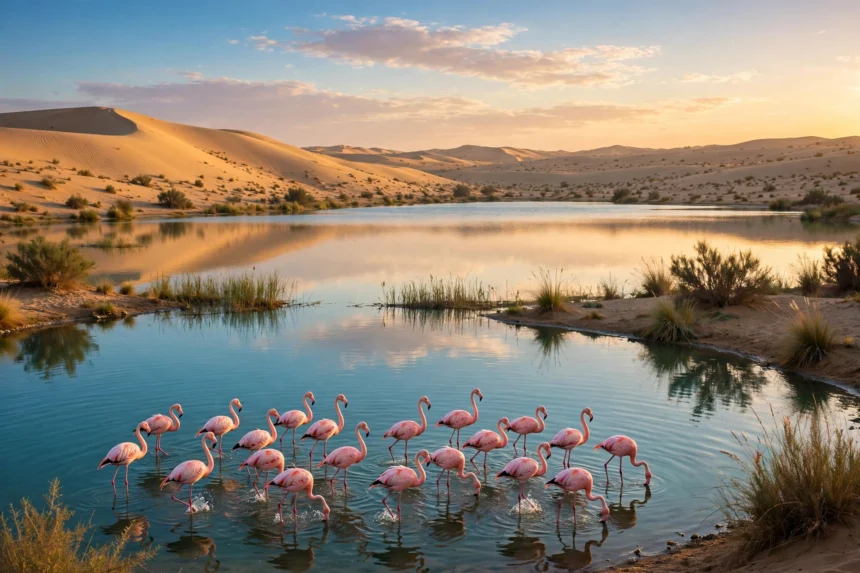
Flamingos are the reason many people visit Al Qudra Lake Dubai United Arab Emirates. The lakes hold one of the largest concentrations of greater flamingos in the UAE, with winter flocks commonly estimated at 300 to 500 birds.
More than 170 bird species have been recorded around the lakes. Swans, ducks, geese, herons and egrets live here year round. The steppe eagle and the Asian houbara appear in the cooler months, and the reserve as a whole records far more species across its full area.
The migratory birds arrive with the cooler weather. November to March is the reliable window for flamingos, and the early morning is when the birds are most active. Arrive at sunrise for the best chance of a busy lake and the softest light.
| Bird | When to look | Where to look |
|---|---|---|
| Greater flamingo | November to March | Flamingo Lake and Expo Lake shallows |
| Swans and ducks | Year round | The main lakes and Family Lake |
| Herons and egrets | Year round | Reed beds at the lake edges |
| White stork | December to February | Family Lake margins |
| Steppe eagle | Cooler months | Open desert around the lakes |
Bird hides and viewing towers stand near some of the lakes. They are worth climbing for the view across water and dunes together. Bring binoculars if you have them, and keep your distance from the birds.
Do not feed the birds. Human food harms them, and feeding changes their behaviour. Watch quietly, stay on the paths, and let the wildlife set the distance.
Arabian oryx and sand gazelles roam the reserve around the lakes. They are shy, and they keep their distance from people. If you spot one, watch from where you stand and do not follow it.
The Al Qudra Cycle Track
The cycle track runs beside Al Qudra Lake Dubai United Arab Emirates, and for many visitors it is the main reason to come. The network totals around 86 kilometres of smooth paved track through the dunes, with a 50 kilometre main loop that most riders treat as the classic ride.
The track was recorded by Guinness in November 2022 as the longest continuous cycling path, at 80.6 kilometres according to the Roads and Transport Authority. Shorter loops suit beginners, and a straight stretch riders call the Stick links the car park to the loop.
The track is free to use and open around the clock. Rest areas with shade, toilets and emergency phones sit along the route. The surface is flat and smooth, which suits road bikes and steady riders.
| Route option | Distance | Who it suits |
|---|---|---|
| Full network | Around 86 km | Experienced riders with a full morning free |
| Main loop | Around 50 km | Fit riders who want the classic ride |
| Shorter loops | Under 20 km | Beginners, families and casual riders |
| Lake loop | Around 15 to 20 km | Riders who want the lakes and a shorter ride |
Bike rental is available at the cycle hub near the start of the track, including the Trek Bicycle Store at the Last Exit Al Qudra hub. Rental prices vary by bike type and day of the week, running roughly from AED 50 up to around AED 100. Confirm the current rate when you book, and reserve ahead for weekend mornings in winter, when the rental fleet goes fast.
Ride at dawn in the warmer months. Carry at least two litres of water per rider, wear sun protection, and ride clockwise with the main flow of riders. Most groups ride clockwise, so going the other way leaves you facing the flow.
Things to Do at the Lakes
Cycling and birdwatching lead the list, but the lakes work for slower days too. A picnic on the grassy banks, a walk between the lakes, an hour of photography or a night under the stars all fit the same place.
Picnics work best in the late afternoon in winter. Family Lake has barbecue pits and shaded seating, and the grassy banks near the main lakes suit a blanket and a cool box. Bring everything with you, because there are no shops at the water.
Photography is strongest at sunrise and in the hour before sunset. The still water reflects the dunes, and flocks of birds cross the sky in the early light. The viewing platform at Love Lake and the bird hides give you height for wider shots.
Stargazing is a real option after dark. The desert sky away from the city lights is dark enough to see far more stars than in the city. Arrive before sunset, stay until the sky darkens after 8 in the evening, and bring a torch for the walk back to the car.
Walking between the lakes suits visitors who want a slow morning. The paths around the main lakes are flat and easy. Wear walking shoes rather than sandals, because the sand is soft in places and the ground is uneven away from the paved areas.
If you want another water spot in Dubai after the lakes, La Mer Beach Dubai United Arab Emirates offers sand, swimming and food outlets in the city. For a beach day further north, Long Beach Ras Al Khaimah gives you a long stretch of sand with mountain views.
Rules Worth Knowing Before You Go
The lakes are a conservation reserve first and a picnic spot second. The rules protect the wildlife, and rangers can close sections to protect nesting birds, so respect the signs on the day.
Swimming is not allowed in the lakes. These are wildlife lakes, not bathing spots, and the water is not managed for swimmers. Stay on the banks and enjoy the view from dry land.
Barbecues are allowed only in marked spots, on charcoal in a stand rather than on the sand. Fires lit directly on the sand can draw fines. Check the signs at your lake before you light anything.
Camping rules differ by spot, so check the signs on the day before you pitch a tent. Camping at the water’s edge has been banned, and the safest choice is to camp well back from the water or not at all. Never leave a fire unattended, and take all rubbish with you.
Keep the lakes clean. Bring rubbish bags, because bins are scarce by the water.
Do not drive off the roads into the reserve. Drones and loud music are restricted, so leave both at home.
What to Pack
There are no shops at the lakes, so your bag decides how comfortable the visit is. Pack for sun, wind and a long stay with no facilities nearby.
- Water, at least two litres per person, more if you plan to cycle
- Food and snacks, plus a cool box for a picnic
- Sunscreen, a hat and sunglasses
- A rubbish bag for everything you bring in
- Binoculars for birdwatching
- A camera or a phone with a full charge
- Walking shoes, not sandals
- A light jacket for early mornings and evenings in winter
- A torch if you plan to stay after sunset
- Cash or a card for bike rental and food trucks at the cycle hub
The Best Time to Visit
The best time to visit Al Qudra Lake Dubai United Arab Emirates is October to April, with November to March as the sweet spot. Daytime temperatures sit in the comfortable range, the flamingos are present, and you can stay outside for hours.
Summer visits need more planning. Go early in the morning or late in the afternoon, and skip the middle of the day entirely. The desert sun is strong, shade is scarce, and the heat builds fast after 10 in the morning.
| Month | What to expect |
|---|---|
| October | Cooler days return, good for cycling and picnics |
| November to March | Best season, flamingos present, comfortable all day |
| April | Warming up, mornings and evenings still pleasant |
| May to September | Very hot, visit only at dawn or after sunset |
Weekends are busier than weekdays. Friday and Saturday mornings in winter draw the biggest crowds of cyclists and families. Weekday mornings are much quieter, and they suit anyone who wants the lakes nearly to themselves.
Sunset is the most popular hour. Arrive an hour before sunset if you want a good spot to watch it. The sky over the dunes turns gold and pink, and the water holds the colour long after the sun drops.
Questions Visitors Ask
Is Al Qudra Lake free to enter?
Yes. Entry to the lakes is free, and the area is open 24 hours a day. There is no ticket office and no booking system.
You only pay for the drive there, and for bike rental if you hire one.
Can you swim in Al Qudra Lake?
No. Swimming is not allowed in the lakes. They are wildlife lakes inside a conservation reserve, and the water is not managed for swimmers.
The lakes are for watching, walking, cycling and picnicking.
When do the flamingos arrive?
Flamingos arrive with the cooler weather and are reliably present from November to March. Early morning is the best time to see them, when the birds are most active and the light is soft. Flamingo Lake and the Expo Lake shallows are the best places to look.
How long is the Al Qudra cycle track?
The track network totals around 86 kilometres, with a 50 kilometre main loop. Guinness recorded it in November 2022 as the longest continuous cycling path, at 80.6 kilometres according to the Roads and Transport Authority. Shorter loops under 20 kilometres suit beginners and families.
Is Love Lake the same as Al Qudra Lake?
No, but they sit in the same lake system. Love Lake is one pair of heart-shaped lakes inside the wider Al Qudra chain, a short drive from the main lakes. It is the most photographed of the lakes, while the main lakes suit birdwatching and picnics.
Can you camp at Al Qudra Lake?
Camping rules differ by spot, so check the signs on the day. Camping at the water’s edge has been banned, and fires on the sand can draw fines. The safest choice is to camp well back from the water, or to visit for the day and leave before dark.
How do I get there without a car?
There is no public transport to the lakes. A taxi or a ride-hailing car is the only option without your own car, and you should arrange a return ride in advance. Taxis do not wait at the lakes.
Is it good for children?
Yes, for children who enjoy the outdoors. The flat paths suit walking, the birdlife keeps younger visitors interested, and Family Lake has barbecue pits and shaded seating for picnics. Bring water, snacks and sun protection, because there are no shops at the water.
A Desert Day That Costs Nothing
The lakes give you a side of Dubai that the malls and towers never show. Still water in the middle of sand dunes, flamingos in winter, oryx in the distance, and a cycle track that runs for tens of kilometres through open desert.
It works as a two-hour sunrise stop or a full picnic-and-cycling day. If you want a green, quiet break from the city, Nahda Park Sharjah is another option closer to the city, with lawns and play areas for families.
Pick your lake, arrive early, and bring water and a rubbish bag. The rest of the day takes care of itself.