
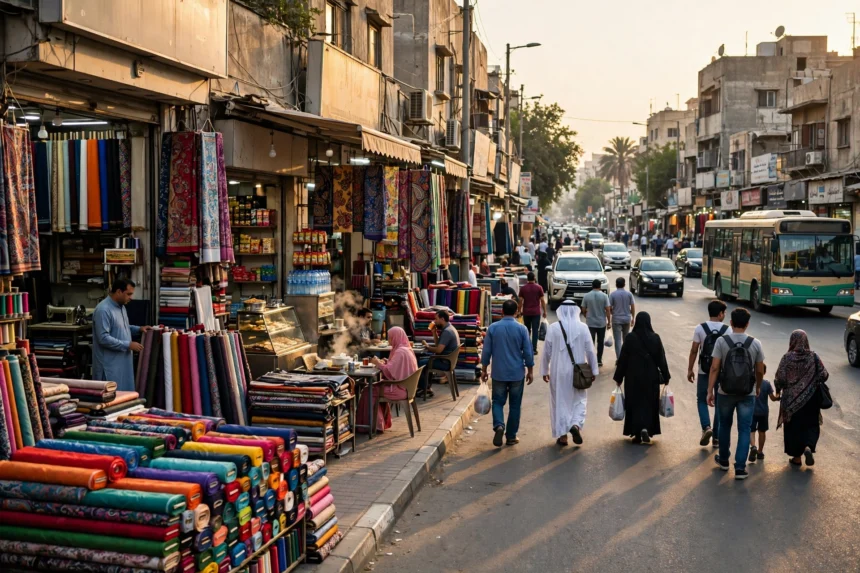
Al Satwa Road is a 7.4 kilometre street that cuts through one of Dubai’s oldest neighbourhoods. It runs from the old Bastakiya quarter in Bur Dubai, through Al Satwa and Al Mankhool, and ends in Al Safa near Jumeirah. Most visitors come for three things: tailors and fabric shops, cheap and honest food from a dozen countries, and a look at everyday Dubai that the malls never show.
- What D 90 Is and Where It Runs
- The Satwa Junction Change in October 2026
- A Walk Down the Street
- Tailors and fabric shops
- Plant Street and the plant nurseries
- Satwa Market and everyday shopping
- Barbers, cafeterias and street life
- Where to Eat Along the Street
- Shopping Without the Mall Prices
- Getting There
- When to Visit and What to Know First
- Why This Street Still Matters
- Places Nearby Worth the Short Trip
- Questions People Ask
This street will not impress you with glass towers or fountains. It impresses in a quieter way. Shopkeepers know their regulars by name.
A suit can be stitched while you wait nearby. Dinner for a family can cost less than a single main course in a hotel restaurant. If you want to understand how most of Dubai actually lives, start here.
What D 90 Is and Where It Runs
Al Satwa Road is officially D 90, a 7.4 kilometre route that runs roughly parallel to D 92 and D 94. It begins in the old Al Bastakiya area of Bur Dubai and ends in the locality of Al Safa. Along the way it passes through Al Mankhool and Al Satwa, two of the city’s oldest residential districts.
The road has collected several names over the years. It is also known as Al Multaqa Street. The stretch through Al Mankhool was called Al Mankhool Road until 2020, when it was renamed Sheikh Sabah Al Ahmad Al Jaber Al Sabah Street in memory of the former Kuwaiti emir.
Older residents still use the old names, and taxi drivers answer to all of them.
The route is easy to follow on a map. Its major junctions tell the story of the neighbourhoods it connects.
| Junction | Road | What it connects |
|---|---|---|
| D 75 | Sheikh Rashid Road | Bur Dubai and the creek side |
| D 73 | 2nd December Street | The Satwa junction and Jumeirah |
| D 71 | Al Safa Street | Al Safa and the Jumeirah side |
| D 84 | Al Seef Street | Southern end near Al Safa |
Landmarks along the route include Al Bastakiya, Al Souk Al Kabir, Jumbo Electronics, Al Khaleej Centre, the Majestic Hotel and the Trade Core Business Center. None of these is a tourist attraction in the usual sense. They are working buildings in a working part of the city, and that is exactly the point.
The road sits between two very different Dubais. Sheikh Zayed Road and its towers run along one side. Jumeirah and its villas and beaches lie on the other.
The street itself belongs to neither world. It is low rise, busy, noisy in the daytime and full of small businesses that have survived decades of change around them.
The Satwa Junction Change in October 2026
The biggest recent change to Al Satwa Road came in October 2026, when Dubai’s Roads and Transport Authority finished converting Satwa Roundabout into a signal controlled junction. For years the roundabout was the meeting point of the district. It joined the road with 2nd December Street and Al Hudaiba Street, just off Sheikh Zayed Road.
The RTA said the project cuts journey time through the junction by 50 percent. It also said peak hour waiting times and queues fall by up to 60 percent. The work improves traffic from 2nd December Street towards the Trade Centre and Al Satwa, and it makes bus access into and out of the area easier.
Locals still call it Satwa Roundabout, and they probably always will. The name works in an address line, in a taxi instruction and in a delivery note. If you ask a driver for the roundabout, you will be understood.
If you say “the new junction”, you may get a blank look.
The change matters for visitors too. Crossing on foot is now a matter of waiting for a green man rather than judging gaps in a circling stream of cars. The junction also links Al Satwa with Al Bada’a, Al Jafiliya, Al Hudaiba and Jumeirah, so it remains the natural starting point for any walk around the area.
A Walk Down the Street
The best way to experience Al Satwa Road is on foot, slowly, with no fixed plan. Start at the junction end and walk towards Bur Dubai. The first thing you notice is the sound: sewing machines, shop shutters, delivery bikes, and conversations in half a dozen languages.
Tailors and fabric shops
Satwa is famous across Dubai for its tailors. Men and women come from all over the city to have suits, kanduras, dresses and uniforms stitched here. The fabric shops come first.
Rolls of cotton, silk, linen and suiting cloth fill the shopfronts, and the tailors work a few doors down.
A few practical points help first timers.
- Bring a garment that fits well if you want something copied. The tailor can measure from it.
- Agree the price and the collection date before the cloth is cut.
- Allow at least two fittings for a suit. Simple alterations can be done the same day.
- Cash is common in the smaller shops, though many now take cards.
Prices are far below mall tailors, and the work is often better. The shops survive on repeat customers, so a bad job costs them more than it costs you. Ask your hotel concierge or a local colleague for a name if you want a personal recommendation.
Plant Street and the plant nurseries
One side street off the main road is known as Plant Street. Its nurseries sell potted plants, garden supplies, ceramic pots and small trees. It is a cheerful detour even if you have no garden.
The sellers are happy to explain what survives a Dubai summer and what needs shade.
Satwa Market and everyday shopping
Satwa Market is the district’s busy souk area. Expect textile stalls, cheap electronics, phone repair shops, watch sellers, perfume counters, household goods and small groceries. It is not a polished tourist souk.
It is a market for residents, which is why the prices stay honest.
Bargaining is normal for electronics and watches. It is not expected in the supermarkets or for fixed price goods. A polite counter offer and a smile work better than a hard line.
If the seller will not move, the price is the price.
Barbers, cafeterias and street life
Old barber shops that have run since the 1960s still operate along the side streets. Small cafeterias serve karak tea, fresh juice and snacks through the day. The street stays busy well into the evening, and the crowd changes as the day goes on: workers in the morning, shoppers in the afternoon, families after sunset.
Where to Eat Along the Street
Food is the other big draw of Al Satwa Road. The restaurants here are decades old, family run and priced for residents rather than visitors. Most of them sit on or just off 2nd December Street, within a short walk of the junction.
| Restaurant | Cuisine | Why people go |
|---|---|---|
| Ravi Restaurant | Pakistani | Biryani and curries, open since the 1980s |
| Al Mallah | Lebanese | Shawarma, manakeesh and fresh juice since 1979 |
| Chowking | Filipino | Familiar fast food from the Philippines |
| Jollibee | Filipino | Fried chicken and rice meals |
| Automatic Restaurant | Arabic grill | Mixed grills and Levantine dishes |
| Small cafeterias | South Asian, Iranian, Filipino | Karak tea, snacks and quick cheap meals |
Ravi Restaurant is the best known name on the street. It has been written about by international food writers, yet it still serves workers and families at local prices. Order the biryani or a curry with fresh naan, and expect a queue at dinner time.
Al Mallah has run since 1979. Its shawarma and manakeesh are the standard by which regulars judge every other shawarma in Dubai. The fresh juice counter is worth a stop on its own.
The Filipino community is large here, which is why the area is often nicknamed Mini-Manila. Chowking and Jollibee sit a short walk from the junction, and smaller Filipino bakeries and groceries fill the side streets. If you have never tried Filipino fast food, this is the cheapest place in Dubai to start.
Karak tea deserves its own mention. The small tea stalls serve strong, sweet, spiced milk tea in tiny cups for a dirham or two. It is the drink of the street.
Take one, stand with the crowd, and watch the road go by.
A few eating tips make the visit smoother.
- Most places are casual. No booking is needed anywhere on the street.
- Come hungry and share dishes. Portions are generous.
- Lunch is quieter than dinner. Evenings are lively and crowded.
- Ask for the spice level you want. Staff are used to adjusting it.
Shopping Without the Mall Prices
The street rewards shoppers who know what they want. Fabric is the obvious buy, and tailoring is the obvious service. Electronics repair is another.
Phone screens, laptop fixes and small appliances are repaired in tiny workshops for a fraction of mall prices.
Supermarkets anchor the daily shopping. Union Co-op sits near Ravi Restaurant and is a common meeting point. A Carrefour and a Lulu Hypermarket are a short walk away.
Between them, the street covers everything from a week’s groceries to a wedding suit.
What you will not find is luxury. There are no designer boutiques and no air conditioned atriums. That is the trade off, and for most visitors it is a fair one.
You come here for value, variety and the feeling of a real neighbourhood.
Getting There
Getting to Al Satwa Road is simple, and you do not need a car. The area is one of the best connected older districts in Dubai.
By metro
There is no metro station inside Al Satwa itself. The two nearest stops are both an easy walk away.
- Al Fahidi station on the Green Line is about a 13 minute walk from the heart of the area. It also drops you at the Al Fahidi Historical Neighbourhood, which pairs well with a Satwa visit.
- Financial Centre station on the Red Line is about a 10 to 15 minute walk away.
- World Trade Centre station is around 2 kilometres from the Satwa Bus Station, and buses link the two.
Use the metro in the cooler months and walk. In summer, take a taxi for the last stretch.
By bus
Satwa Bus Station is one of the city’s busiest transport hubs. It sits near the junction and serves routes across Dubai. Buses start running around 5am, and the last departures leave around 11pm.
| Route | Where it goes |
|---|---|
| C01 | Dubai Airport Terminal 3 to Satwa Bus Station |
| X13 | Lulu Village to Satwa Bus Station, an express service |
| F11 | Satwa to the World Trade Centre area |
| 21 | Satwa to Al Nahda |
| 15 | Satwa to Al Quoz and Al Khail Gate |
| E100 | Satwa to Abu Dhabi Central Bus Station, an intercity service |
Bus numbers and times change, so check the RTA S’hail app before you travel. You need a Nol card to ride. Buy one at any metro station and top it up there too.
If you are flying in, start with Terminal 1 Dubai to get your bearings at the airport. The C01 bus then runs from Terminal 3 straight to Satwa Bus Station, which makes the airport trip simple and cheap.
By taxi or car
Taxis are easy to find on the main road, and ride hailing apps work well here. Give the driver the junction or a landmark like Chelsea Plaza Hotel, Hana Centre or Ravi Restaurant. Street names confuse even good drivers in this area, but landmarks never do.
If you drive, expect busy streets and limited parking in the daytime. The side streets fill up fast. Park a little further out and walk in.
Evening peak runs roughly from 5pm to 7pm, and the morning peak from 8am to 9am. Outside those hours the drive is much calmer.
When to Visit and What to Know First
October to March is the best time to walk the street. The weather is cool enough for a slow wander, and the evening crowds give the place its energy. In summer, go early in the morning or after sunset, and duck into the air conditioned shops often.
A few small things make the visit better.
- Wear comfortable shoes. The pavements are uneven in places.
- Dress modestly, as you would anywhere in old Dubai.
- Carry some cash for the small shops and tea stalls.
- Keep your phone secure in the crowds, as you would in any busy market.
- Ask before photographing shopkeepers. Most will agree, and a smile helps.
The street is safe and family friendly. Children are welcome in the restaurants, and the whole area is used to visitors who come to eat, shop and look around. Nobody will push you to buy.
A polite no is enough.
Why This Street Still Matters
Al Satwa Road is not polished, and that is the point. Dubai builds new districts every year, each shinier than the last. This street has kept its shape: low buildings, small shops, family businesses and a mix of nationalities that feels like the city itself.
For residents, it is simply useful. A suit stitched, a phone fixed, dinner sorted, plants for the balcony. For visitors, it is a window into the Dubai that existed before the towers.
The two groups share the same pavements, and the street belongs to both.
That mix is what makes the road worth a visit. You will not tick off a famous sight. You will eat well, spend little, and see a side of Dubai that most itineraries skip.
Places Nearby Worth the Short Trip
The street sits in the centre of Dubai, so several well known places are minutes away.
- Jumeirah Beach is the nearest stretch of sand. There is no beach in Satwa itself, so head north to the Jumeirah coast for a swim.
- The Al Fahidi Historical Neighbourhood, also called Bastakiya, sits at the northern end of the road. Its wind towers and lanes are the oldest surviving part of the city.
- The Dubai World Trade Centre is a short drive away and hosts exhibitions through the year. Traffic around it gets heavy during big events, so check before you go.
- Mall of the Emirates is a short drive away too. The Heritage Building Al Barsha sits right by it, and the contrast between that low rise area and the mall is worth seeing.
- Government services are close as well. The Al Manara Center Dubai Municipality building sits near the southern end of the route, around Al Safa.
If you prefer a quieter residential area after the bustle, Nad Al Hammar Dubai is a calm family pocket on the other side of the city. It makes a good contrast: Satwa for the noise and the food, Nad Al Hammar for the quiet.
Questions People Ask
Where is Al Satwa Road?
Al Satwa Road runs from old Bur Dubai through Al Satwa and Al Mankhool to Al Safa, between Sheikh Zayed Road and Jumeirah. The Satwa junction, where it meets 2nd December Street and Al Hudaiba Street, is the easiest landmark to navigate by.
How long is the road?
The route is 7.4 kilometres long. You would not walk all of it in one go. Most visitors walk the busy stretch around the junction, the market and the restaurants, which takes an hour or two at a slow pace.
What is the nearest metro station?
Al Fahidi station on the Green Line is about a 13 minute walk away. Financial Centre station on the Red Line is about a 10 to 15 minute walk away. Both are easy to reach on foot in the cooler months.
What is Al Satwa famous for?
Tailors and fabric shops, budget restaurants from many countries, Plant Street nurseries and the old Satwa Market. The area is also known for its large Filipino community and its lively street life.
Is it worth visiting as a tourist?
Yes, if you like food, markets and real neighbourhoods. It is not a place for luxury shopping or famous sights. It is a place to eat well, shop cheaply and see everyday Dubai.
Can I get a suit stitched there?
Yes. Bring a garment that fits, agree the price and date first, and allow at least two fittings for a suit. Simple alterations are often done the same day.